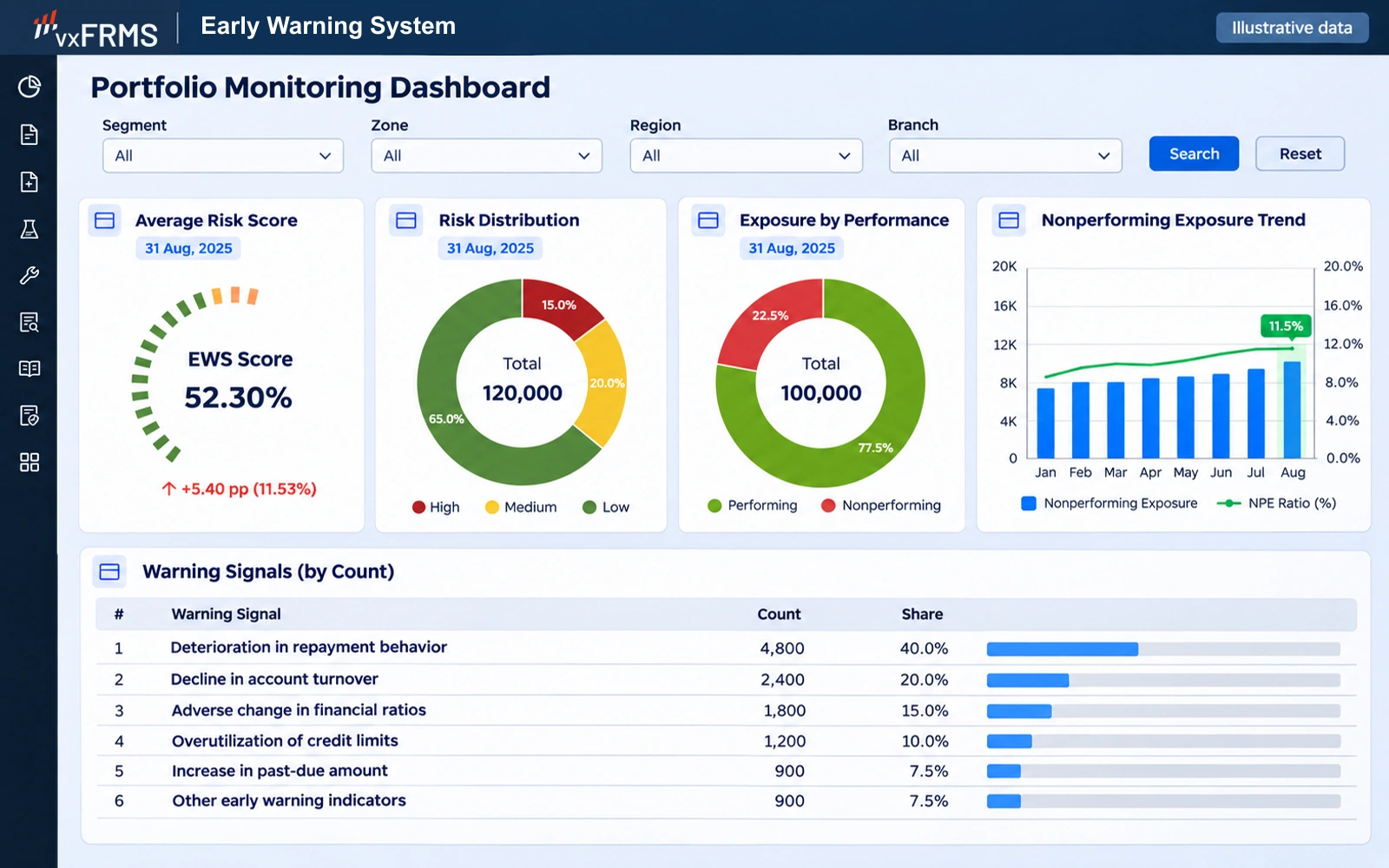
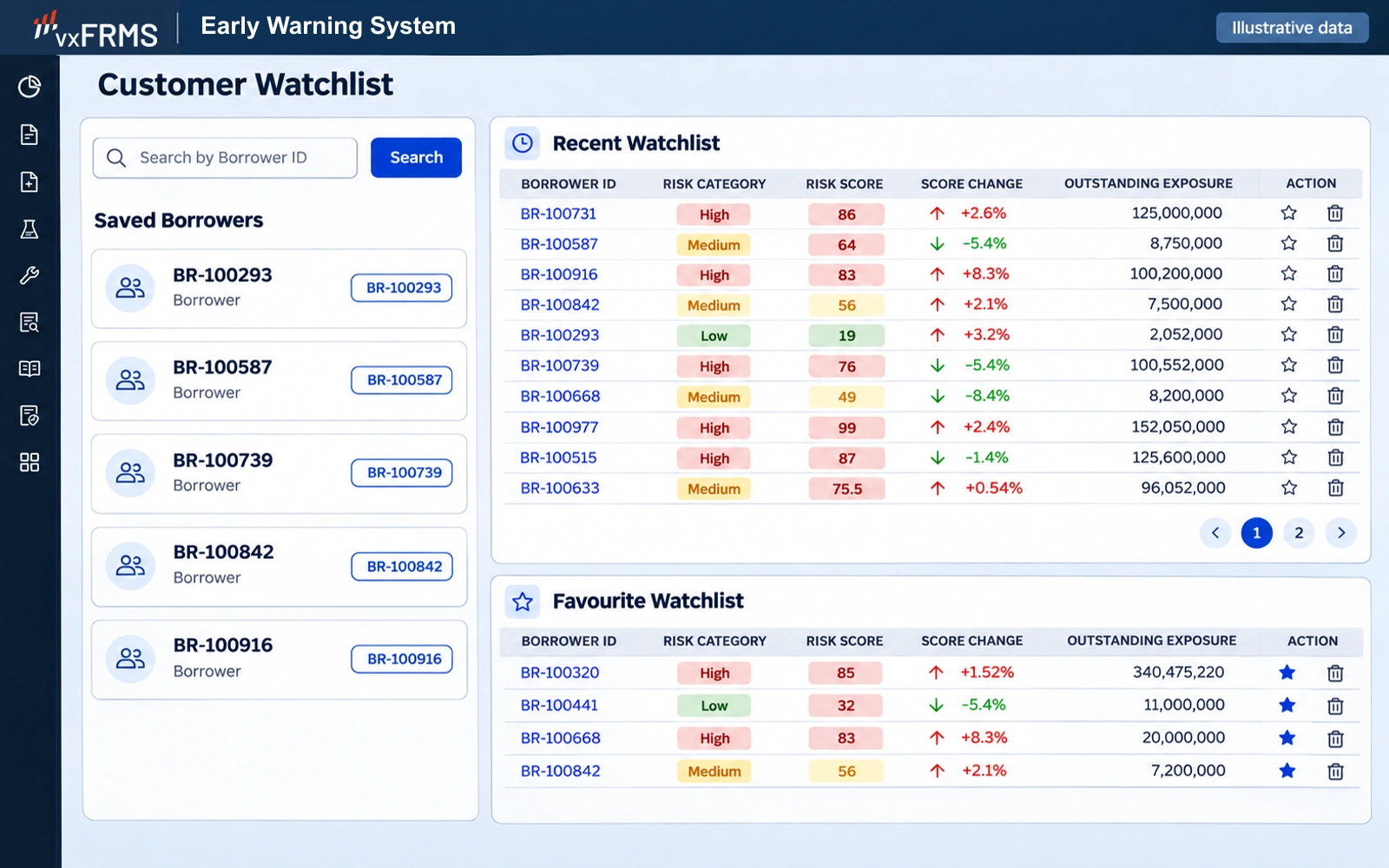
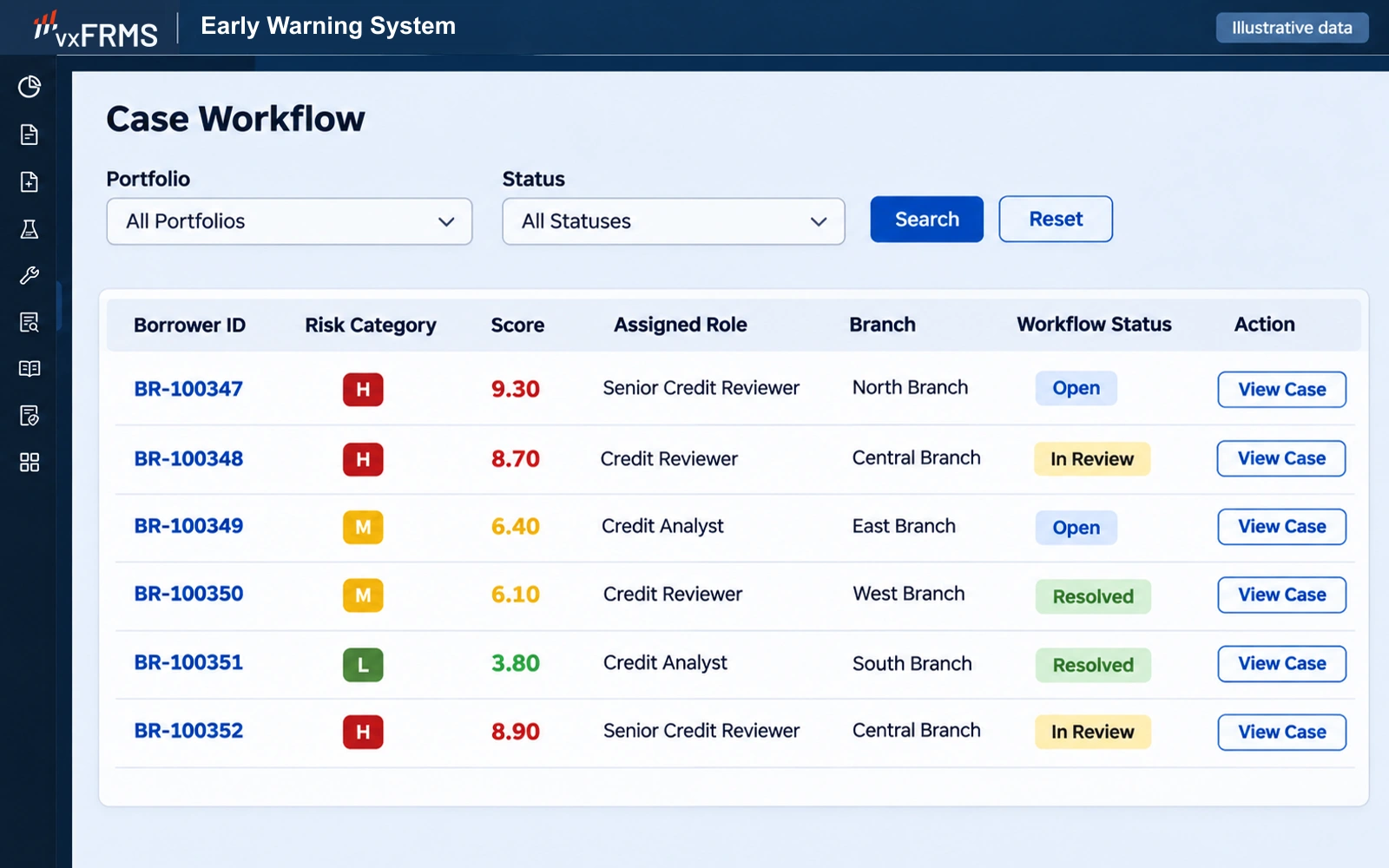
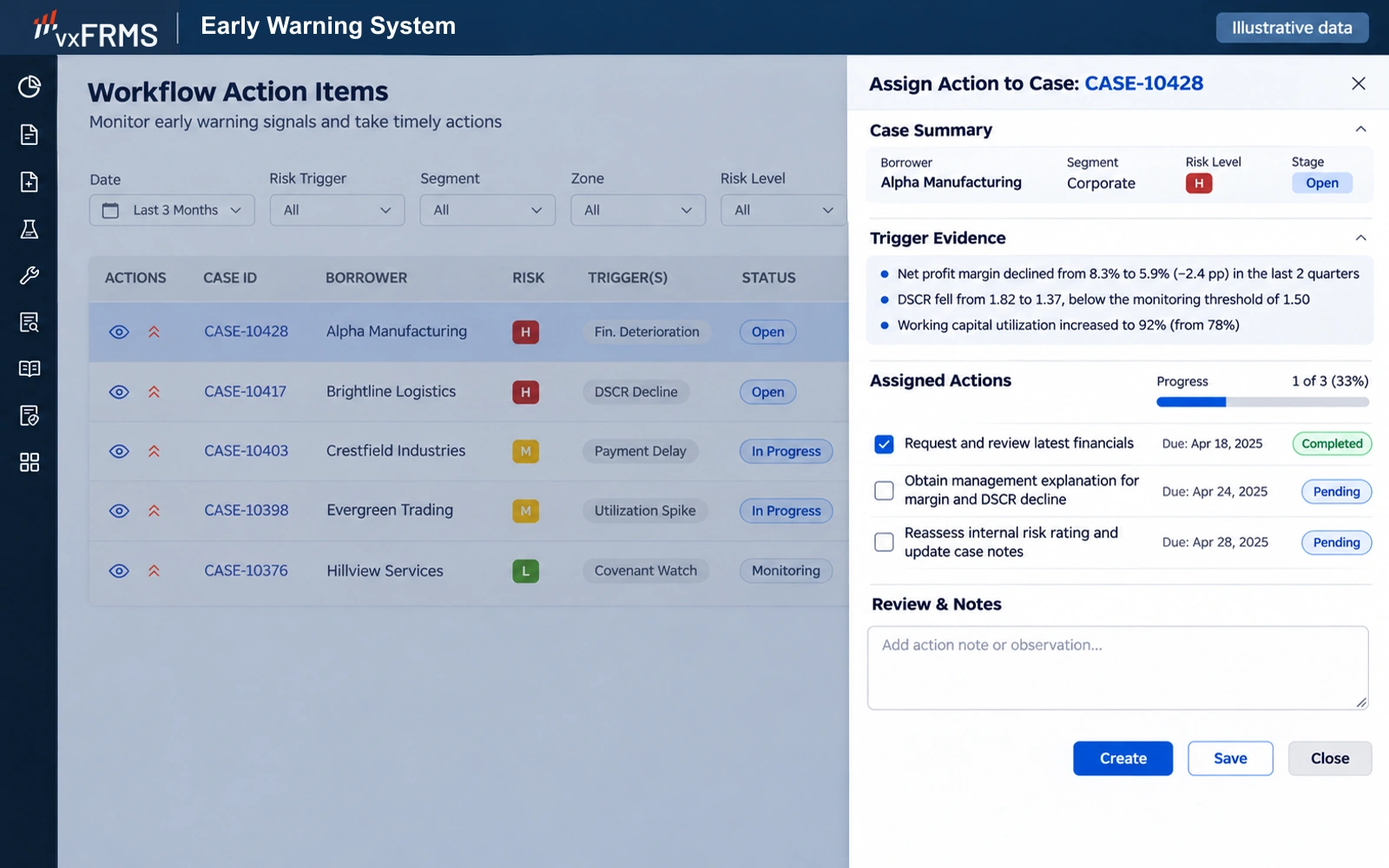
Detect emerging borrower stress, prioritize intervention and connect early-warning evidence with governed IFRS 9 staging on a shared risk-data foundation.
Review borrower risk distribution, non-performing exposure trends, and the most frequent warning signals.
Customer Watchlist
Track borrowers under observation and compare risk scores, recent changes, and outstanding exposures.
Case Workflow
Filter cases by portfolio or status and see who is responsible for reviewing each flagged borrower.
Workflow Action Items
Open a case to review the warning signal, assigned follow-up actions, and progress.
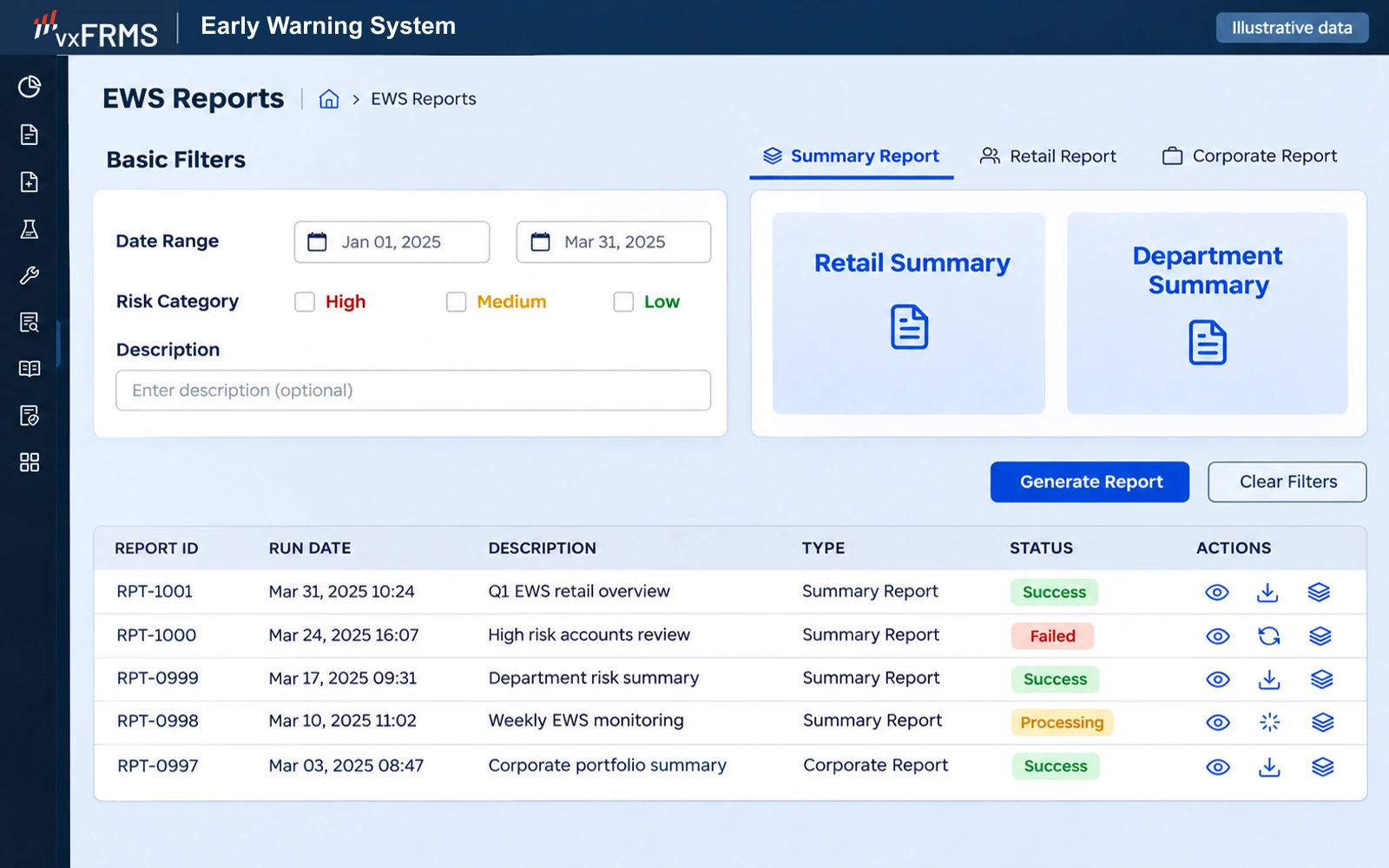
EWS Reports
Generate retail or department summaries and review the status of previous reports.
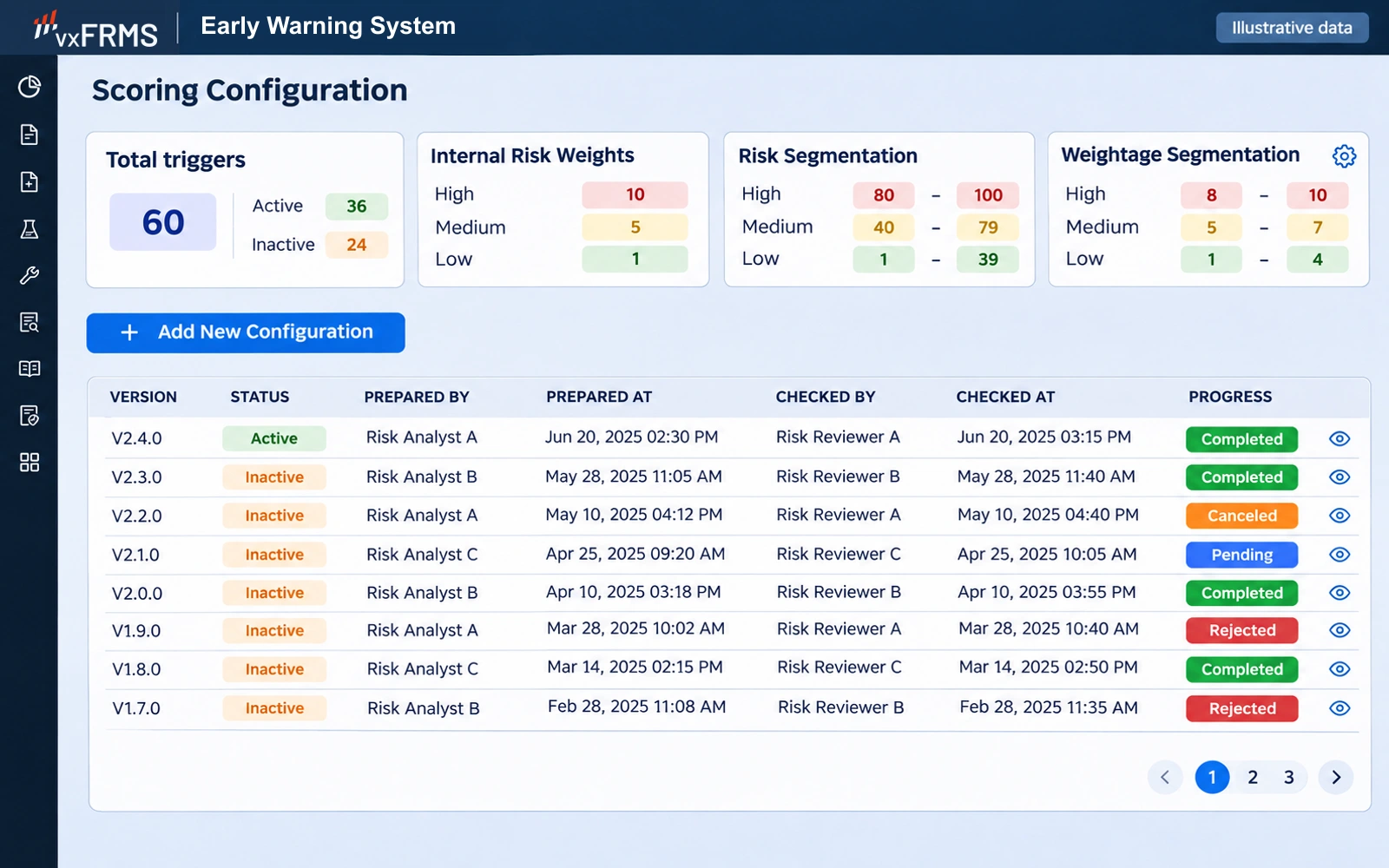
Scoring Configuration
Review trigger settings, risk bands, and the approval history of scoring configurations.
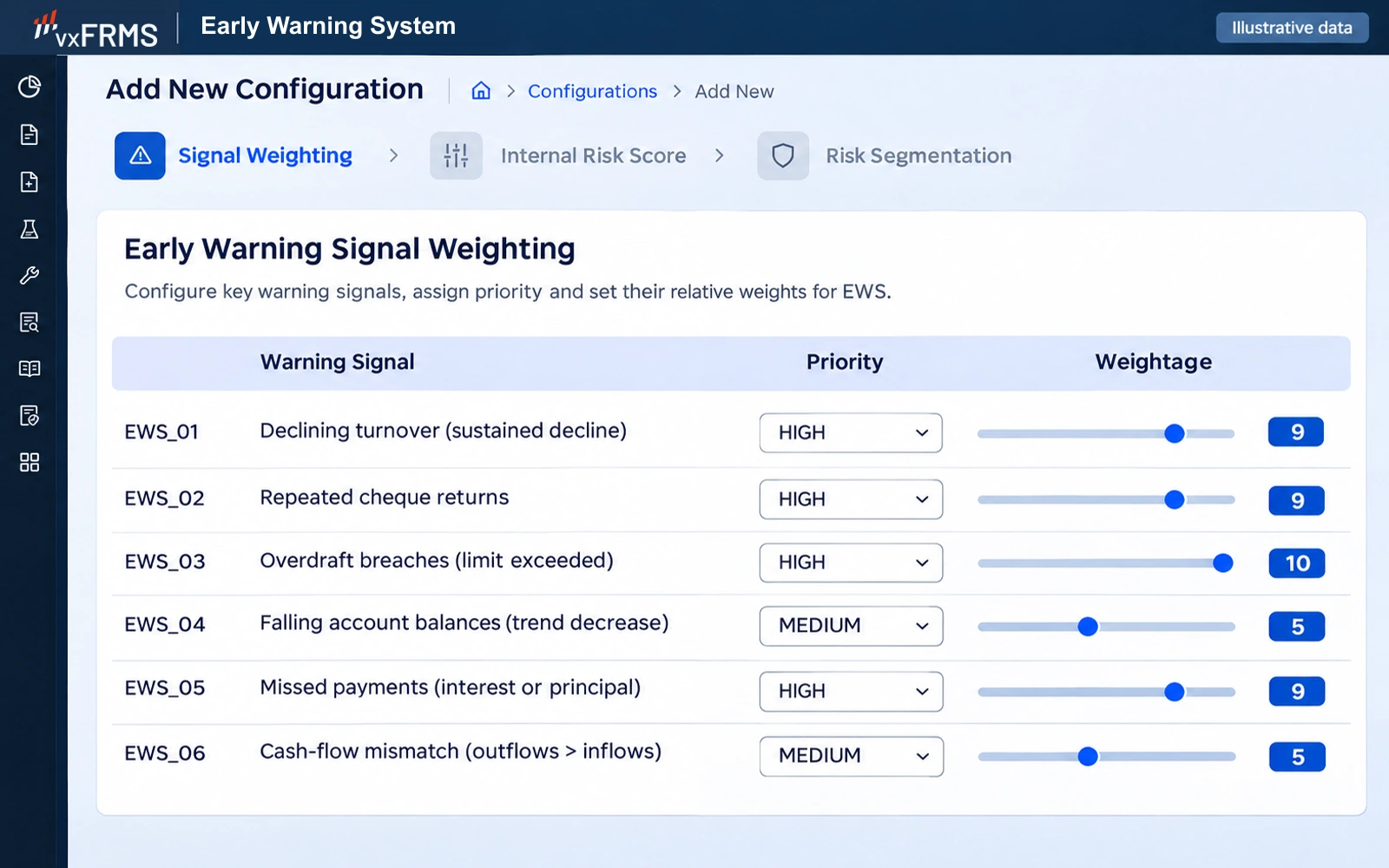
Early Warning Signal Weighting
Set priorities and weights for individual warning signals to reflect their significance to the portfolio.
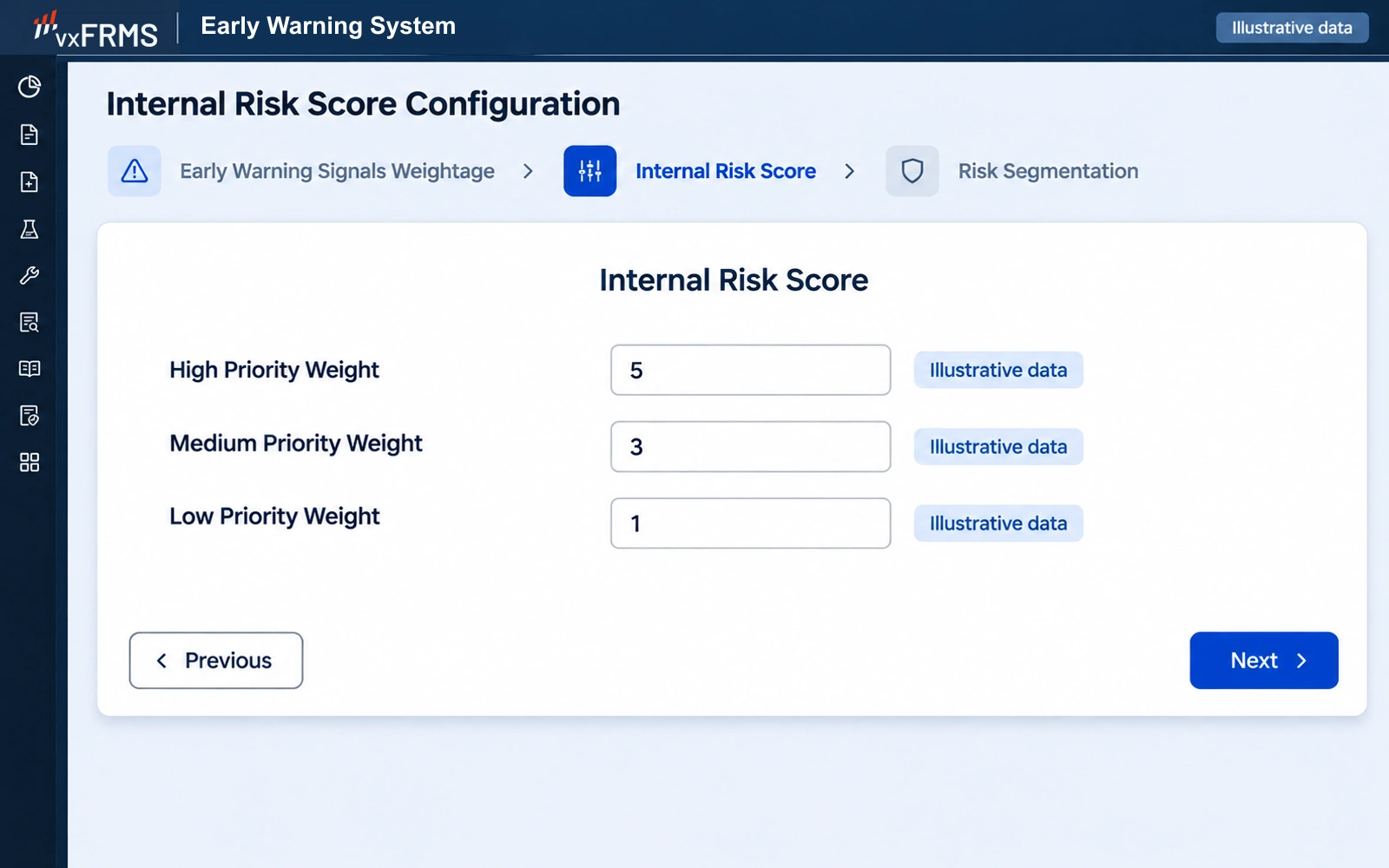
Internal Risk Score Configuration
Set the scores associated with high, medium, and low priority signals.
1 / 8
PROACTIVE CREDIT RISK MONITORING
Recognize stress. Prioritize action.
Combine policy-driven rules with data-driven scoring to monitor customers, facilities and portfolios. Turn emerging changes into alerts, risk scores and accountable interventions before deterioration becomes harder to manage.
A broader view of borrower stress
Configure signals for worsening repayment behaviour, utilization changes, limit excesses, covenant or condition breaches, collateral weaknesses and restructuring indicators. Combine these with falling balances, reduced salary credits or business turnover, cheque returns and cash-flow mismatches.
Customer and contract scoring
Combine financial and behavioural indicators into customer- and contract-level scores. Configure signal priorities, weights and risk bands to reflect your portfolios, then track movements between bands as conditions change.
Watchlists and escalation
Prioritize exposures using trigger breaches, alert severity, risk scores and watchlist changes. Use escalation indicators to direct attention to the cases that require timely review, with portfolio dashboards supporting oversight.
Closed-loop intervention
Where case workflows are enabled, assign an accountable owner, review the evidence and record follow-up actions. Track progress, action status and the documented outcome so warning signals lead to a managed response.
Monitoring at the right frequency
Evaluate indicators on agreed daily, weekly or monthly schedules. Match refresh and evaluation frequency to each source and signal, supporting both ongoing relationship monitoring and periodic risk reporting.
Controlled configuration and reporting
Review scoring settings, signal weights and configuration approval history. Use shared access controls and notifications, generate portfolio or department summaries, and monitor report status through the reporting workspace.
CONNECT MONITORING WITH IMPAIRMENT
From early warning to governed staging decisions.
On the shared vxFRMS platform, EWS can provide structured evidence for IFRS 9 ECL staging. Customer and contract signals enter the SICR assessment through agreed mappings and controls, supporting consistent, explainable Stage 1 and Stage 2 movements under the institution’s policy.
01
Shared risk data
Customer and facility data, repayment behaviour, collateral information and relevant external inputs.
02
EWS signals & scores
Trigger breaches and severity, risk scores, risk-band movements, watchlists and escalations.
03
Governed SICR evidence
Map signals to the institution’s approved significant increase in credit risk (SICR) framework.
Use EWS evidence alongside delinquency and other policy-defined criteria in the impairment staging process.
Open / prioritize cases Evidence for review
Investigation, action and outcome
Assigned case owners review the warning, track intervention and record findings. Documented outcomes and action status feed back into the shared risk record and can inform the SICR review.
Illustrative integration flow. An alert provides evidence for assessment; it does not, by itself, mandate a stage change. Integration, rules and approval paths are configured to the institution’s policy.
Choose the evidence pathway
Configure eligible EWS indicators as rules-based staging evidence, or as recommendations subject to maker–checker review and authorized override. Keep the decision process aligned with the approved SICR methodology.
Use one risk-data foundation
EWS consumes customer, contract and behavioural indicators from the shared vxFRMS Data Store. Structured outputs are written back with timestamps and audit records, ready for use by the ECL module without parallel risk datasets.
Prepare evidence before reporting
Reduce manual evidence compilation and make processed risk signals available for impairment runs. Support repeatable staging inputs and help Risk and Finance explain why a staging decision was made.
A warning is more useful when the team can explain it. Follow the source data, validation and transformation, effective rule version and threshold through to the alert and the recorded response.
01
Source records
Facility limit: 1,000,000 Utilized balance: 950,000 Reporting date recorded
02
Transform & validate
Validate and reconcile inputs. Calculate utilization: 95%. Retain source lineage.
03
Apply the rule
Illustrative threshold: > 90% Utilization rule v2.3 Effective date recorded
04
Generate the alert
Threshold breach: 95%. Score and severity per policy. Alert timestamp recorded.
05
Review & act
Assign an accountable owner. Record action and decision. Track outcome and closure.
An auditable evidence record
Source and reporting period
Validation and transformation
Rule, threshold and version
Alert and review timestamps
Owner, decision and outcome
Illustrative data and rule version only. Thresholds, scores, source integrations and workflows are configured for each institution.
For signals that influence staging, retain the link to the underlying rule, threshold, data points and rule version effective on that date. This gives reviewers a clear evidence chain for operational follow-up, model governance and audit queries.
A GOVERNED DATA FOUNDATION
One credit-risk warehouse. Connected monitoring.
Consolidate heterogeneous internal and external sources in the vxFRMS Data Store, a centralized credit-risk warehouse shared with ECL. Reliable, repeatable pipelines support monitoring, scoring, dashboards and reporting from a common data model.
Extract from your source landscape
Securely read from core banking platforms, supporting applications and external feeds using agreed extraction logic. Schedule daily, weekly or monthly refreshes around source availability and monitoring requirements.
Transform with reusable rules
Cleanse and de-duplicate records; map, validate and enrich inputs; then align them to a common data model. Reusable transformation-rule libraries support maintenance and controlled changes as sources or products are added.
Load with reconciliation and lineage
Load validated data into the shared store with audit support and source lineage. Reconciliation and validation controls help explain the data behind an alert and reduce dependency on manual extracts.
Tailored to your institution
Agree the source integrations, signal catalogue, refresh schedules, scoring methodology, SICR mappings, approval paths and reporting requirements during implementation. The diagrams show configurable solution capabilities; the deployed scope follows your data availability, approved risk policy and governance requirements.